| |
| |

| |
ANTIPODES ISLAND PARAKEET |
| |
Not all parrots live in paradise. The Antipodes Island parakeet Cyanoramphus unicolor, also known as the green parakeet, lives only on Antipodes Island, one of New Zealand's remote, bleak and inhospitable subantarctic islands.
It is part of the Psittacidae family of parrots and parakeets, which belongs to the Psittaciformes order of birds. The Antipodes Island parakeet is listed as 'vulnerable' on the 2009 IUCN Red List of Threatened Species, and 'at risk-naturally uncommon' on the 2008 New Zealand Threat Classification System
The classification of C. unicolor has remained unchanged following the genetic survey of Cyanoramphus species by Boon, Kearvell, Daugherty & Chambers (2001), which doubled the number of species from five to ten.
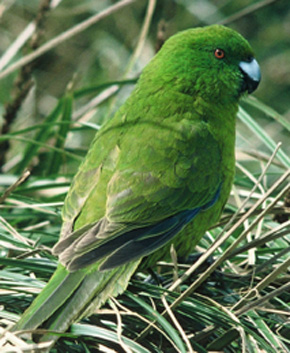
It is the largest of the Cyanoramphus (kakariki) species, 31cm long which is 3cm more than the New Zealand red-crowned parakeet. The Antipodes Island parakeet is the only member of the kakariki family with all green colouring, and without a coloured frontal head band. |
| |
|
| |
 |
| |
| |
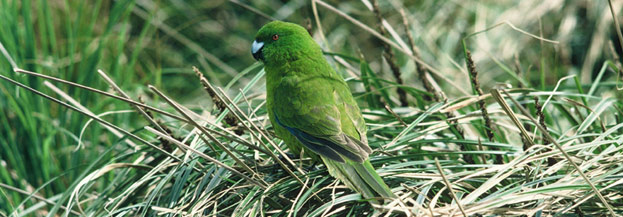
Above: Antipodes Island parakeet Cyanoramphus unicolor
Photo: J.L. Kendrick, Crown Copyright © Department of Conservation. |
| |
 |
| |
The deep separation of the Antipodes Island parakeet from the other New Zealand taxa suggest that Cyanoramphus colonisation of Antipodes Island must have occurred before the radiation of red, yellow and orange-fronted parakeets.
Antipodes Island was colonised twice by two Cyanoramphus species. The Antipodes Island parakeet migrated to the island about 280,000 years ago, and the ancestors of Reischek's parakeet arrived about 30,000 years ago. The two species have co-inhabited the small island for thirty millennium without interbreeding.
The Antipodes Island parakeet breeds very unusualy on the ground like a rabbit. Its nest is in a well drained burrow a metre deep in the fibrous peat under tussock grass. Just two eggs are laid for the season between November and January.
In contrast to the squawking chatter of other Cyanoramphus birds, the Antipodes
species are quiet, letting out a single note when startled. |
| |
| |
|
The Antipodes Islands are also the only home of Reischek's parakeet Cyanoramphus hochstetteri.
It was originally described as C. novaezelandiae hochstetteri, together with the extinct Macquarie Island red-crowned parakeet C. novaezelandiae erythrotis, both as subspecies of the New Zealand red-crowned parakeet C. novaezelandiae. |
| |
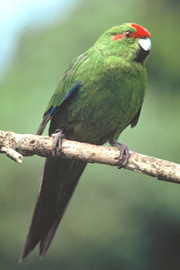
Reischek's parakeet is very similar in appearance to the New Zealand red-crowned parakeet. The paper "Molecular systematics and conservation of kakariki", Boon et al, 2001 elevated many red-crowned subspecies to full species.
Right: New Zealand red-crowned parakeet, J.L. Kendrick Crown Copyright © Department of Conservation |
 |
| |
|
With the Boon et al. research, the Macquarie Island parakeet became C. erythrotis, and Reischek's parakeet C. erythrotis hochstetteri, the only surviving subspecies of it.
However, the research was flawed because the origin of the Macquarie specimen material was the Antipodes Islands. So Reischek's parakeet has now been elevated to the full species C. hochstetteri.
C. erythrotis was endemic to Macquarie Island, the only subantarctic island of the group that is in Australian territory, and the most southerly at 54.5°South latitude. The island was infested with cats, and is still inhabited by rabbits, mice and ship rats which were mainly responsible for extinction of the parakeet.
Weka Gallirallus australis scotti were introduced from New Zealand in the mid-1800s as food for sealers, and contributed to the extinction of the Macquarie Island parakeet and the Pacific banded rail. Weka are no longer on the island.
Because Antipodes Island is closer to the New Zealand mainland, which is the apparent centre of origin of Cyanoramphus parakeets, it is likely that C. hochstetteri colonised Antipodes Island first, later migrated further south to Macquarie Island, and radiated to C. erythrotis.
The sister species of the critically endangered orange-fronted parakeet C. malberbi is not the yellow-crowned parakeet C. auriceps, but Reischek's parakeet.
Reischek's parakeet has adapted to the harsh subantarctic island conditions in a similar way to its co-inhabitant, the Antipodes Island parakeet, with the same ground feeding, roosting and nesting habits. The two species often share the same feeding locations.
Even though there is a healthy population of Reischek's parakeet, its very limited distribution on one island makes it vulnerable to extinction. It has the same listing as the Antipodes Island parakeet, as 'at risk-naturally uncommon' on the 2008 New Zealand Threat Classification System.
|
| |
|
| |
 |
| |
|
|
Above: Antipodes Island parakeet Cyanoramphus unicolor.
Photo: J.L. Kendrick, Crown Copyright © Department of Conservation 1978.
.

Ground-dwelling parakeets on a cold, windy, bleak & unforested subantarctic island ......
The Cyanoramphus parakeets have adapted to a wide range of habitats, from tropical rainforest to subantarctic tussock.
In stark contrast with the tropical forested habitat of the New Caledonia red-crowned parakeet C. saisetti, Antipodes Island is a cold, wind-swept island exposed to regular storms of the rooring forties, with the principal flora limited to two species of tussock grass, ferns and some stunted shrubs. There are no trees on the island.
Antipodes Island is New Zealand's third most southern territory at 49.7°South latitude, 700 km southeast of the South Island mainland. The entire area of 62 sq.km is designated as Nature Reserve administered by the Department of Conservation, with very limited access.
The island is one of five in the New Zealand Subantarctic World Heritage Site which also contains The Snares, Bounty Island, the Auckland Islands, and Campbell Island.
Unlike Campbell Island to the south, which had the world's most dense rat population before they were removed in 2001, Antipodes Island has remained rat-free. However, it would only take one pregnant rat to get ashore from an anchored fishing boat to set off a rat plague that could destroy both of the island's ground inhabiting parakeets.
| |
|
| |
Antipodes Island is second to the Auckland Islands as the most southern Cyanoramphus parakeet location, and the world's third most southern parrot location. |
| |
|
| |
The Austral parakeet Enicognathus ferrugineus of Tierra del Fuego (54.7°South latitude) at the bottom of Argentina and Chile, is the most southerly distributed parrot.
The parakeets on Antipodes Islands have little fear of humans and a strong curiosity. It is possible to approach them to within 2 metres while they are feeding without disturbing them.
Both species of parakeet use the tussock vegetation as a food source, for nesting, and shelter from the harsh, consistent wind and rain. Nests are normally a tunnel in the base of a tussock.
The favourite food of both Antipodes Island parakeets is a tall dense tussock Poa litorosa, mainly because it is one of the few choices. In typiical kakariki style, they cut off 25cm pieces, and hold them in one claw while chewing from end to end.
Other seasonal food includes seeds, flowers and berries, and the Antipodes Island parakeet occasionally supplements its diet with meat from the carcases of dead gulls and penguins, and eggs.
Both Antipodes parakeets have had no choice but to adopt ground-dwelling habits, and would therefore be obvious candidates to become flightless, like so many other New Zealand birds without predators. But even without natural or introduced predators, both species are good fliers.
Parakeets have survived on Antipodes Islands while other animals have not been able to tolerate the inclement climate. Animals were released on subantarctic islands as a source of food for castaways and sealing gangs. Cattle, sheep and goats were introduced to Antipodes several times but died out.
It is remarkable that large healthy colonies of two different parakeet species, share the same remote and limited island habitat, and that both are endemic to the island.
The Antipodes Island parakeet and Reischek's parakeet both need second populations on predator-free islands, to provide a complete safeguard for their protection. |
| |
A reflection of the lifestyle of New Zealand parakeets during the last ice-age .....
The rapid adaptive radiation of the Cyanoramphus genus was probably assisted by fluctuating glacial and interglacial intervals of the Pleistocene, 2 million to 10,000 years ago.
During the last glacial (before 14,000 years ago) and post glacial periods, predominant grass and shrub vegetation, with patches of Nothofagus in the central North Island, provided the habitat of Cyanoramphus parakeets on mainland New Zealand.
The mainland vegetation before the ice retreated resembled that of present Antipodes Island and Macquarie Island. The present lifestyle of one of the more ancient Cyanoramphus lineages, C. unicolor, and Reischek's parakeet C. hochstetteri on Antipodes Island are a reflection of the New Zealand glacial conditions.
Campbell Island is another remote island in the subantarctic group that has a similar treeless vegetation. It is known from a bone specimen, to have been occupied by an unidentified parakeet that has long been extinct.
Reischek's parakeet appears to come from the mainland New Zealand stock of red-crowned parakeets, as the result of an independent colonisation event.
The extinct Macquarie Island red-crowned parakeet also occupied habitat similar to that of Reischek's parakeet. This supports the hypothesis which suggests that Macquarie Island may have been colonised by Reischek's parakeet, from which the C. erythrotis species evolved.
The rapid transformation of the vegetation on the mainland between 10,000 and 9,000 years ago defines the end of the glacial period, and the beginning of the climate of today. Rimu quickly became the most predominant podocarp, and the start of a new forested habitat for mainland and offshore island parakeets. This was not so for the subantarctic island parakeets.
|
|
| |
|