|
|
|
NEW ZEALAND ECOLOGY |
| |
|
|
WATTLEBIRDS |
| |
| |
The North Island saddleback Philesturnus rufusater and South Island saddleback Philesturnus carunculatus, also known as tieke, are two of five endemic New Zealand wattlebird species in the Callaeidae family, of the Passeriformes order of perching birds.
The Callaeidae family is highly distinguished, because the entire family is endemic to New Zealand. There are an exceptionally high number of 14 endemic families in the New Zealand terrestrial animal kingdom.
Callaeidae wattlebirds, the extinct huia, and kokako and saddleback, have an ancient lineage, migrating to New Zealand 60 million years ago.
Here, in isolation, and free from mammalian predators, like many other New Zealand birds, saddleback adopted ground-feeding habits, and a lesser ability to fly.
North Island and South Island saddleback were recently described as separate species, after formerly being separated as subspecies P. carunculatus rufusater and P. carunculatus carunculatus respectively. |
| |
 |
| |
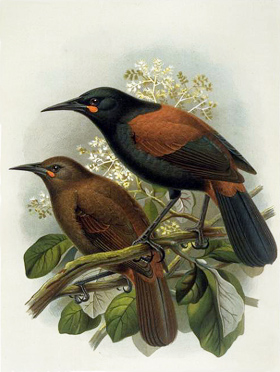
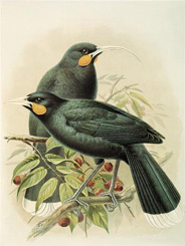
An adult South Island saddleback (right) and a juvenile, known as a jack bird, with brown colouring that will change to that of the adult.
Image: John Gerrard Keulemans 1842-1912, Jack-bird Creadion cinereus, saddleback Creadion carunculatus 1888. Permission of the Alexander Turnbull Library, National Library of New Zealand, must be obtained before any re-use of this image. |
| |
 |
| |
Before large areas of forest were cleared and predator mammals such as rats and stoats were brought to New Zealand, saddleback were one of the most common birds in native forests on both mainland islands. By 1900 they were only found on offshore islands.
The North Island saddleback has a threatened listing in the 2012 New Zealand Threat Classification System of 'at risk - recovering', after a 2008 listing of 'range restricted'. |
| |
Successful comeback of North Island saddleback .....
The comeback of the North Island saddleback Philesturnus rufusater is one of the early success stories of New Zealand native bird conservation.
In 1964, only about 500 birds remained on Hen Island in the Hen and Chicken Islands off the Whangarei coast. Some were moved to adjoining Whatupuke Island, in the first native bird translocation in New Zealand by Wildlife Service biologists.
Another early translocation moved North Island saddleback to predator-free Cuvier Island in the Hauraki Gulf north of the Coromandel Peninsula, where they have thrived. Cuvier has become an aviary supplying saddleback to other islands.
North Island saddlebacks have gone from a remnant population of 500 birds on one island to over 6,000 on 12 islands with the capacity to increase to 19,000 individuals [Hooson & Jamieson, 2003].
The total habitat area is about 7,000 hectares on Whale Island in the Bay of Plenty; Stanley, Red Mercury and Cuvier Islands off the Coromandel coast; restored Tiritiri Matangi Island, and protected Little Barrier Island in the Hauraki Gulf; Hen, Coppermine, Whatupuke, and Lady Alice Islands outside Whangarei Harbour; and Motutapu/Rangitoto Islands, and Motuihe Island, Auckland.
Translocations to Fanal Island off Whangarei, and Motukawanui and Moturoa Island further north were unsuccessful.
There is only one location off the west coast of the North Island at Kapiti Island off Wairarapa.
Translocations have been successful to five areas protected by predator-free fences, re-establishing North Island saddleback in natural habitat on the mainland for the first time in 100 years. They were reintroduced to Karori Sanctuary in Wellington from Tirirtiri Matangi Island in 2002.
Other fenced sanctuary translocations include Bushy Park Forest Reserve, Whanganui in 2006, Tawharanui Regional Park, Auckland in 2012, and in 2013 to Cape Sanctuary, Hawke’s Bay and Maungatautari Ecological Island in the Waikato. A breeding population is held in captivity at the National Wildlife Centre at Mount Bruce. |
| |
|
| |
 |
| |
| |
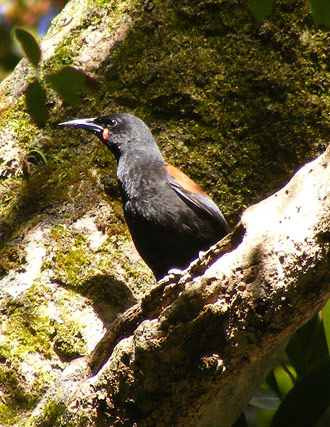
A South Island saddleback Philesturnus carunculatus, also known as tieke on Ulva Island, 2008. Photo D-rew at en.wikipedia.
 See more on wattlebirds See more on wattlebirds
See more on fruit-eating birds
Saddlebacks are very vocal, especially the male with his repertoire of melodious calls used during mating and in territorial disputes.
 Hear the song of North Island saddleback Hear the song of North Island saddleback
MP3 1,745K 1 min 51 sec.
Hear the song of South Island saddleback
MP3 1,406K 1 min 29 sec.
Crown Copyright © Department of Conservation |
| |
 |
| |
The near extinction and survival of South Island saddleback .....
At the turn of the 20th century, the South Island saddleback Philesturnus carunculatus was also extinct on the mainland island, and limited to Big South Cape Island, Pukeweka Island, and Solomon Island off the southwest coast of Stewart Island.
In 1964, ship rats got ashore on Big South Cape Island from a wrecked boat, and quickly spread to Pukeweka and Solomon Islands. This resulted in New Zealand's worst ecological disaster in modern times, and the fastest extinction of three species, the Stewart Island snipe, Stead's bush wren, and greater short-tailed bat.
After opposition to intervention by biologists within the New Zealand Wildlife Service (now the Department of Conservation), proponents of action in the department succeeded in rescuing the last 36 South Island saddleback from the brink of extinction five months after rat invasion.
South Island saddleback have gone from a remnant population of 36 birds on one island to over 1,200 birds spread among 15 island populations, with the present capacity to increase to a maximum of 2,500 birds [Hooson & Jamieson, 2003]. These islands are small, covering a total area of 500 hectares.
Around Stewart Island, there have been translocations to Kundy, Betsy, Big, Kaimohu, Putauhinu, and Pohowaitai Islands off the southwest coast; and to North, Womens, Motunui, Jacky Lee and Ulva Islands off the northeast coast. Original populations have been restored on Solomon, Pukeweka and Big South Cape Islands.
Populations have been established on Breaksea and South Passage Islands in Fiordland, and Motuara and Allports Islands in the Marlborough Sounds. Translocations to Inner Chetwode Island in Cook Strait, and Maud Island in the Marlborough Sounds were unsuccessful.
South Island saddleback P. carunculatus has a threatened listing in the 2012 New Zealand Threat Classification System of 'at risk - recovering', which is an upgrade from their previous status of 'nationally endangered'. It is listed as 'near threatened' on the IUCN Red List of Threatened Species.
Saddleback habits
Saddlebacks are not particularly good fliers, which makes them susceptible to predation, and limits their dispersal from islands they have been translocated to. They are noisy, inquisitive, tame, and quite conspicuous, and have not adapted to avoid introduced mammalian predators they were not accustomed to before the arrival of humans.
As saddlebacks mainly inhabit the lower forest, roosting in tree holes near the ground, and probing on the ground through litter for weta, grubs and other insects, they are more vulnerable to mammal predators such as stoats, rats and possums.
Like their close relative the kokako, the poor flying ability of saddleback limits them to bounding from branch to branch in the middle and lower layers of the forest.
Saddleback also eat the fruit of forest trees such as kawakawa and coprosma, so habitat loss was another factor in their extinction on the mainland.
South Island saddlebacks younger than 15 months (called "jack birds") have dark brown plumage, as shown in the illustration above. The chestnut colored saddle forms on its back after the second time it moults.
Juvenile North Island birds get their "saddleback" marking before leaving the nest. The North Island race is slightly different with a distinct narrow pale margin on the front edge of the saddle.
They are a medium sized bird of 25 cm, weighing 70 to 80 grammes, with both adults having a similar appearance. The female has smaller orange wattles and weighs about 10g less than the male. |
| |
|
| |
|
A seed disperser of native plants ....
About 70 percent of woody plants in New Zealand forests have fruits suited for vertebrate dispersal and, of these, most are probably dispersed by birds. About 70 percent of New Zealand's forest bird species, including most small insectivores, eat fruits [Clout & Hay 1989].
Across 32 studied species of native fleshy-fruited plants, the majority (84 percent) of fruit dispersal was by four birds - kereru, tui, bellbirds and silvereyes - although another 11 native and 7 introduced bird species took small quantities of fruit [Kelly et al. 2006].
Despite being primarilly insect-ivorous, saddleback are also a fruit-eating and nectar feeding bird that assists an essential function in the ecological sustain-ability, and restoration, of lowland forests by pollinating flowers and dispersing seeds.
Saddleback would have been effective seed dispersers and pollinators in mainland forests before both species became extinct on the North and South Islands.
| |
 |
| |
When formerly present in mainland forests, saddleback assisted an essential function in the ecological sustainability and restoration of forests by dispersing seeds and pollinating flowers. |
| |
|
| |
All the fruits of mid-sized plant species (mean diameters 10–14 mm), and the smaller fruits of the largest-fruited (mean >14 mm) species, are dispersed by mid-sized native birds such as tui, kokako and saddlebacks. [Kelly et al, 2009]
The saddleback's gape, which is the width of the outside of the bill at the base of the upper mandible is an average of 7.1mm, and a maximum of 9mm. It swallows whole kohekohe Dysoxylum spectabile fruit which is 9mm in diameter, larger than the medium sized gape.
Important pollinators of native plants .....
Native birds have been recorded visiting the flowers of 85 native species, representing 5 percent of the total seed-plant flora, and 30 percent of the tree flora [Kelly et al. 2009].
Birds that visit the flowers of forest plants throughout New Zealand are the tui, bellbird, stitchbird, silvereye, kokako, red-crowned parakeet, yellow-crowned parakeet, kaka, kea, whitehead, yellowhead and saddleback.
In most of the mainland forests, the only birds that commonly visit flowers are bellbird, tui and silvereye, since stitchbird and saddleback are extinct on the mainland, and kaka and parakeets only rarely occur in large forest tracts.
| |
|
| |
References
Clout M.N., Hay J.R., The importance of birds as browsers, pollinators and seed dispersers in New Zealand forests, New Zealand Journal of Ecology, Vol 12 (supplement) 1989.
Hooson S., Jamieson I.G., The distribution and current status of New Zealand saddleback Philesturnus carunculatus, Bird Conservation International (2003) 13:79–95.
Kelly D., Ladley J.J., Robertson A.W., Anderson S.H., Wotton D.M., Wiser S.K., Mutualisms with the wreckage of an avifauna: The status of bird pollination and fruit-dispersal in New Zealand, New Zealand Journal of Ecology, (2010) 34(1): pp 66-85. |
| |
|
| |
 |
|














 CLICK IMAGE TO VIEW NEXT