|
| |
 |
|
|
| |
|
|
|
| |
Two species of flightless brown teal are endemic to New Zealand and are some of the rarest
ducks in the world. Anas nesiotis and Anas aucklandica are closely related, and found only on their respective very bleak but beautiful subantarctic islands. They were originally on the New Zealand mainland, and are related to three flighted species, the endemic brown teal Anas chlorotis, with endangered South Island and North Island subspecies; grey teal Anas gracilis, a 19th century natural immigrant from Australia; and chestnut teal Anas castanea still stuck in Australia. |
| |
|
|
|
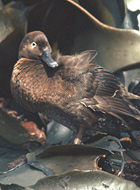
The endangered flightless Auckland Island teal is endemic to the Auckland Island group. It has had an easier time surviving in the harsh subantarctic environment than its close Campbell Island relative, because it is on small predator-free islands and islets off the main Auckland Island. The two subantarctic teals are the smallest of the Australasian teals, with shorter pointed wings. They are semi-nocturnal and a combination of sea duck and terrestrial duck, feeding and roosting in bull kelp beds on the shoreline, as well as on land
 See more See more |
 |
|
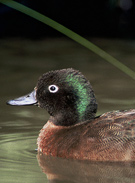
The flightless Campbell Island teal is critically endangered and the world's rarest duck. It was thought to be extinct for 100 years, before 20 survivors were found in 1972 on Dent Island, a tiny rock islet. Captive-bred birds originating from one female, were translocated back to their former range on Campbell Island over three years, which is the last stop before Antarctica. After reaching the next lowest population to black robin, it has survived New Zealand's second-most critical brink of extinction.
See more |
 |
|
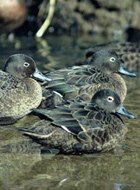
Unlike subantarctic teal brown teal can fly, but are less interested in it than typical ducks. It is endemic and threatened. The main group of the North Island subspecies is on Great Barrier Island, and there are small groups at two Northland locations, and on Kapiti, Mana and Tiritiri Matangi Islands. Brown teal arrived in New Zealand much later than A. aucklandica and A. nesiotis about 10,000 years ago, and are more closely related to the Australian chestnut teal and grey teal.
See more |
 |
|
The South Island subspecies of brown teal is most likely functionally extinct, but with reasonable doubt that the last individuals have died. Fossil records from 16 South Island sites show that it occupied a wide range. Habitats were as diverse as coastal dunes, lagoons, lakes, waterways, swamp forests, and wet podocarp forests. South Island locations ranged from Stewart Island marine habitat without freshwater, to silver beech and dry mountain beech forests up to an altitude of 800m.
See more |
 |
|
Grey teal is another small flighted teal that is more widespread in Australia, and migrated to New Zealand in the 19th century. Although it became widely distributed throughout New Zealand, the population is limited to a few locations. Grey teal are one of the country's smallest ducks, that has a preference for nesting in holes in trees.
See more |
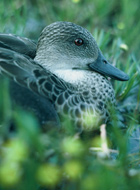 |
| |
|
| |
2012 New Zealand Threat Classification System
Campbell Island teal
Anas nesiotis
Nationally critical
Auckland Island teal
Anas aucklandica
Nationally vulnerable
South Island brown teal
Anas chlorotis 'South Island'
Data deficient (taxonomically indeterminate)
Brown teal
Anas chlorotis 'North Island'
At risk-recovering
Blue duck
Hymenolaimus malachorhynchos
Nationally vulnerable
Grey duck
Anas superciliosa
Nationally critical
Australasian shoveler
Anas rhynchotis
Not threatened
Paradise shelduck
Tadorna variegata
Not threatened
New Zealand scaup
Aythya novaeseelandiae
Not threatened
Grey teal
Anas gracilis
Not threatened |
| |
Extinct ducks, geese and swans .....
Auckland Island merganser
Mergus australis
Blue-billed duck
Oxyura australis
New Zealand musk
(De Lautour's duck)
Biziura delautouri
Chatham Island duck
Pachyanas chathamica
Finsch's duck
Chenonetta finschi
Scarlett's duck
Malacorhynchus scarletti
North Island goose
Cnemiornis gracilis
South Island goose
Cnemiornis calcitrans
New Zealand swan
Cygnus sumnerensis |
| |
 |
| |
 |
|
|
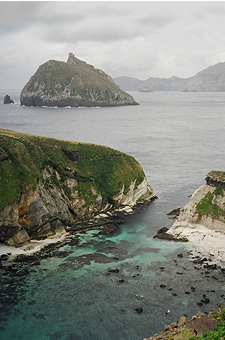
Above: Dent Island 1.6 km off Campbell Island, where 20 Campbell Island teal Anas nesiotis were rediscovered in 1972, after it was thought to be extinct for 150 years. Photo Crown Copyright © Department of Conservation
 See more on Campbell Island teal See more on Campbell Island teal
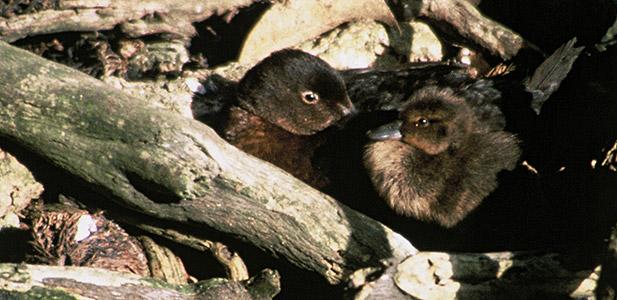
Above left: A female Auckland Island teal Anas aucklandica with her duckling, nestled in driftwood. Photo Crown Copyright © Department of Conservation
See more on Auckland Island teal |
| |
 |
| |
2008 IUCN Red List of Threatened Species
Campbell Island teal
Anas nesiotis
Critically endangered
Brown teal
Anas chlorotis
Endangered
Auckland Island teal
Anas aucklandica
Vulnerable
Blue duck
Hymenolaimus malachorhynchos
Endangered |
| |
|
| |
Photo credit
Center top; Auckland Island teal roosting in bull kelp, Rod Morris, Crown Copyright © Department of Conservation 1973.
Center 2nd down; 1st photo male Campbell Island teal, Garry Norman, Mt Bruce 1995, 2nd photo female Campbell Island teal, Barry Harcourt, Crown Copyright © Department of Conservation.
Center 3rd down; Brown teal Anas chlorotis 'North Island', Greta Barrier Island 1974, Dick Veitch, Crown Copyright © Department of Conservation
Center 4th down; Brown teal, Copyright © Geoff Moon
Center bottom; Grey teal Anas gibberifrons, Crown Copyright © Department of Conservation. |
| |
|
|