|
|
| |
 |
| |
Home > New Zealand ecology > Teal > Campbell Island teal |
| |
| |
| |
The endemic, flightless Campbell Island teal Anas nesiotis is a dabbling duck belonging to the Anatidae family of waterfowl (ducks, geese and swans), of the Anseriformes order.
Two remarkable, tough little flightless ducks, that are only found on two cold, wet and windswept subantarctic islands, are another anomaly of the isolated evolution of New Zealand ecology.
The Campbell Island teal Anas nesiotis and the Auckland Island teal Anas aucklandica have been isolated in New Zealand for a long time, and subsequently became flightless and semi-nocturnal.
Before gaining full species status, Anas nesiotis was regarded as a subspecies of A. aucklandica. They are each endemic to their respective island groups. |
| |
 |
| |
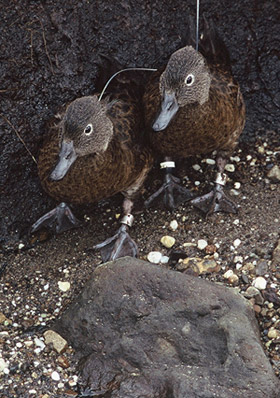
Two translocated female Campbell Island teal Anas nesiotis, banded and fitted with transmitters.
Photo Crown Copyright © Department of Conservation.
 See slideshow of larger teal images See slideshow of larger teal images |
| |
 |
| |
The two subantarctic teals are the smallest of the Australasian teals, with shorter pointed wings. They are semi-nocturnal and a mix of sea duck and terrestrial duck, feeding and roosting in kelp beds on the shoreline, as well as on land.
New Zealand's subantarctic teal are two of the world's few remaining flightless ducks. Others include two species of flightless steamer duck, Tachyeres pteneres from Tierra del Fuego, Chile at the bottom of South America, and Tachyeres brachypterus which is endemic to the Falkland Islands, off the coast of Argentina.
Campbell Island teal are rarely seen as they are nocturnal. They make up for their inability to fly, by running very fast as a means of escape at the first sign of any disturbance. |
|
|
| |
 |
| |
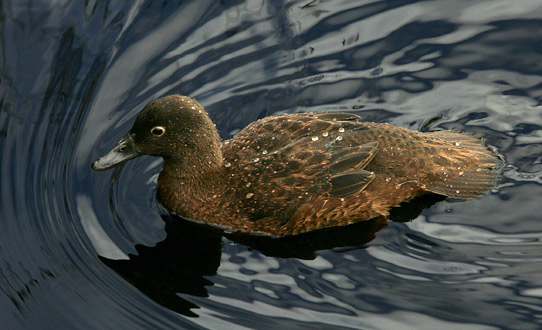
Above: 1st image - female; 2nd image - male and female Campbell Island teal. Right: Dent Island from Campbell Island.
Photos Garry Norman (male Mt Bruce 1995), Barry Harcourt (female), Peter Moore (2nd Dent Island), Crown Copyright © Department of Conservation.
Mouse over to view 2nd image, click on 2nd image to see slideshow, mouse out to restore 1st image
See slideshow of larger teal images
See Auckland Island teal
See more on teal |
| |
|
| |
One of the closest brink of extinction recoveries
The Campbell Island teal is the rarest duck in the world, listed as 'critically endangered' on the IUCN 2005 Red List of Threatened Species, and 'nationally critical' on the 2009 New Zealand Threat Classification System.
The brink of extinction survival of Campbell Island teal has been just as spectacularly close as the black robin's, which got down to one breeding female and four males.
The first naturalists that landed on Campbell Island in 1840 found plenty of seabirds, but no land birds - all of them had been wiped out by rats that got ashore from whaling and sealing ships.
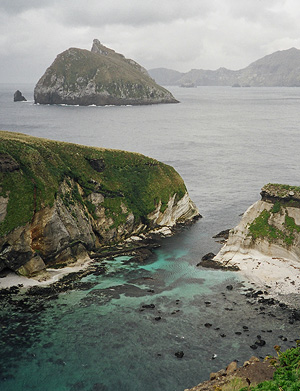
In 1975 when Campbell Island teal were thought to have been extinct for 150 years, 20 hardy survivors were rediscouvered on Dent Island (shown above right).
The 23 ha rock and scrub covered islet 1.6 km off the main island, was the salvation of teal survivors because it had remained rat-free. |
| |
|
| |
When it was thought to have been extinct for 150 years, 20 Campbell Island teal were rediscouvered on Dent Island in 1975. |
| |
|
| |
At latitude 52.5° South, Campbell Island runs a close second to Tierra del Fuego (latitude 54.9° South) as the world's most southern duck location.
Domestic livestock struggled and humans could not live in the extreme subantarctic conditions, but Campbell Island teal had survived for thousands of years before sealers and whalers arrived in the subantarctic.
An accurate count could not be made in 1975, but it is thought that the total population amounted to no more than 20. Teal had totally disappeared from all of the other islands in the group, mainly due to predation of rats in the early 19th century.
With a limited food supply on Dent Island, seabird guano became part of the Campbell Island teal's diet.
|
|
|
| |
 |
Prevention of extinction with captive breeding & translocation
Since the removal of cats and rats from Campbell Island which started in 2001, and no remaining trace of them in 2003, translocated teal from captive breeding are expected to occupy their former entire range on the island within five years.
Captive breeding was started in 1984. Because of uncertainty over the number of teal on Dent Island, and concern for taking too many birds off, 3 males and 1 female were captured for breeding. With no duckling arrivals, another 4 males and 3 females were captured in 1990.
The first ducklings got world attention when they finally hatched in 1994 at the Pukaha Mt Bruce National Wildlife Centre. By 2000, the captive population of Campbell Island teal had reached 60.
The Department of Conservation initially chose to establish a second population on Whenua hou/Codfish Island, a predator-free island off Stewart Island, as a precautionary backup population while Campbell Island was cleared of rats, and to prepare the teal for their final move.
| |
|
| |
After a decade of unsuccessful captive breeding, the first ducklings got world attention when they hatched in 1994. |
| |
|
| |
Two releases on Codfish Island of a total of 24 captive bred birds in 1999 and 2000 had an 88 percent rate of survival. With this success, DoC decided to translocate Mount Bruce bred birds directly to Campbell Island.
Fifty teal, including 28 from Pukaha Mount Bruce and 22 from Codfish Island were released onto Campbell Island in September 2004. Tracking in early 2005 confirmed 35 of the 50 birds to be alive.
In April 2005 there were 51 teal at Pukaka Mount Bruce after 20 ducklings hatched during the season. Translocations of 55 birds to Campbell Island in the spring of 2005, and another 54 in 2006 to different sites on the island, successfully completed the recovery program.
In March of 2006 new nests and ducklings confirmed a prosperous future for the world's rarest duck, and for a revived avifauna on Campbell Island.
A tiny population of Campbell Island snipe was discovered in 1997, during a search for teal on the 19 hectare Jacquemart Island rock stack. After rat eradication, snipe have returned to the main island naturally, with 30 birds found in 2006.
The future of Campbell Island's land birds is still subjected to keeping the island rat-free.
|
| |
 |
| |
|