|
|
| |
 |
| |
Home >
NZ ecology >
Mammals > Long-tailed bat |
| |
| |
NEW ZEALAND ECOLOGY |
| |
|
|
MAMMALS |
| |
| |
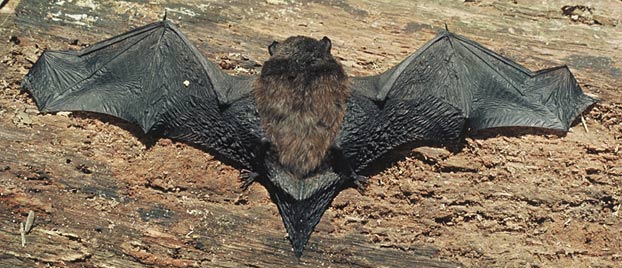
The long-tailed bat Chalinolobus tuberculata, also known as the long-tailed wattled bat, is a member of the Vespertilionidae family. It is endemic to New Zealand, and was identified by Forster in 1844.
It is is closely related to five species of lobe-lipped or wattled bats that are widely distributed throughout the southwest Pacific in Tasmania, Australia, New Caledonia, New Guinea and Norfolk Island.
It is New Zealand's smallest bat with a weight of 8-11 grams, and is very different from the other two native short-tailed species.
Long-tailed bats arrived in New Zealand during the Pleistocene 1-2 million years ago, much later than the short-tailed bats. They came in the same direction, as a windblown migrant across the Tasman Sea. |
| |
 |
| |
In the 1800s, long-tailed bats were commonly found in colonies of hundreds or thousands throughout New Zealand. In 1930 they were scarce in many areas. |
| |
|
| |
As the more common New Zealand bat, the long-tailed is widely distributed. The North Island subspecies Chalinolobus tuberculata (North Island) is found throughout the North Island and on Kapiti Island, and Little Barrier and Great Barrier Islands. The largest population is in the Whareorino Conservation Area in the southern King Country.
The South Island subspecies Chalinolobus tuberculata (South Island) is in half of the mainland island and on Stewart Island.
Long-tailed bats are by no means prolific breeders as one would expect, producing only one pup a year. |
| |
Acutely threatened status .....
Chalinolobus tuberculatus is listed as 'vulnerable' on the 2007 IUCN Red List of
Threatened Species.
The 2005 New Zealand Threat Classification System names the long-tailed bat as the species "Chalinolobus tuberculata" whereas most scientific references use the species name "tuberculatus".
The North Island subspecies Chalinolobus tuberculata (North Island) is acutely threatened with a 'nationally vulnerable' listing in the 2005 New Zealand Threat Classification System.
The South Island subspecies Chalinolobus tuberculata (South Island) is listed as 'nationally endangered'. Both subspecies are regarded as taxonomically indeterminate. |
| |
|
|
|
| |
Long-tailed bat Chalinolobus tuberculatus, Ngongotaha Hatchery, Rotorua.
Photo J.L. Kendrick, Crown Copyright © Department of Conservation 1973
 View two larger images View two larger images
Greater short-tailed bat
Short-tailed bat |
| |
 |
| |
The importance of old roost trees
Roost trees are normally in mature, open-structured lowland forest on areas of relatively flat valley floor within 500 metres of the forest edge.
Selection of specialised roosts, high roost lability and low levels of roost re-use indicate that C. tuberculatus need large areas of mature forest (Sedgeley, O'Donnell 1999). |
| |
 |
| |
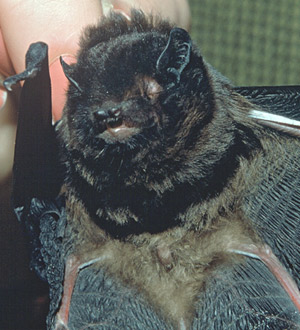
Long-tailed bat Chalinolobus tuberculatus, Gisborne Photo: Dick Veitch, Crown Copyright © Department of Conservation 1975
View two larger images |
| |
|
| |
Long-tailed bats do not choose specific tree species, but select roost trees on the basis of their functional requirements. They tend to select taller trees with a relatively low canopy, larger stem, larger trunk surface area and more cavities.
Red beech Nothofagus fusca and dead trees are most likely to provide the bat's preferred conditions.
Many roost trees are 100 to 600 years old, and are most often targeted for removal under forest management practices. The low availability of suitable mature roost trees outside protected areas, limits bat populations. |
|
| |
|
| |
Differences between the only two surviving native land mammals .....
A membrane is attached to the tail of the long-tailed bat, whereas the short-tailed bat's tail is shorter and free. The attached membrane is used to scoop insects in flight.
In contrast with ground feeding short-tailed bats, the long-tailed bat is an aerial insectivore that eats mosquitos, moths, beetles and midges.
It has a homing range of 100 sq.km and can reach speeds of up to 60 kph, whereas the short-tailed bat is a very poor flier, never getting much higher than three metres off the ground.
The greater distribution and number of long-tailed bats, compared to short-tailed, is an example of better survival of New Zealand's stronger flying animals, that are less reliant on ground habitation and less vulnerable to introduced predators.
The long-tail bat's echo-location calls include a relatively low frequency component that can be heard by humans with suitable hearing. The long-tailed frequency is 40 kHz, and the lesser short-tailed frequency is 27-28 kHz, with the lower frequency representing the larger body size. |
| |
| |
 |
| |
| |
The long-tailed and lesser short-tailed bat are the only New Zealand native terrestrial mammals, since the greater short-tailed bat became extinct. |
| |
| |
|
| |
| |
Long-tailed and short-tailed bats have complex social systems, with both species using a series of communal and solitary day-time roosts.
Long-tailed and short-tailed bat roost locations studied in Fiordland were both found to be in large, old-aged red beech Nothofagus fusca trees with similar characteristics.
Short-tailed bat roosts were significantly closer to the ground, with more entrances, and larger entrance and interior space dimensions. The roosts of both species were well insulated to maintain stable temperatures.
The average number of 310 in the roosting group, and the roost occupation period of six to seven days for short-tailed bats, were higher than long-tailed bats. |
| |
| |
|
| |
| |
 |
|