|
|
| |
 |
| |
Home > New Zealand ecology > Teal > Brown teal |
| |
| |
| |
The endemic brown teal Anas chlorotis, also known as New Zealand teal and the Maori name pateke, is a dabbling duck belonging to the Anatidae family of waterfowl including ducks, geese and swans, of the Anseriformes order.
The brown teal is a relatively recent arrival in New Zealand, migrating from Australia about 12,000 years ago according to fossil records. Anas chlorotis was described by Gray in 1845 from specimens collected by Earl in 1840.
Unlike its' close subantarctic flightless relatives, the brown teal is still a flier, but a weak and reluctant one. It prefers to swim away when disturbed, instead of flying.
It is more closely related to the Australian chestnut teal Anas castanea, a vagrant that migrates in small numbers but does not breed in New Zealand, and grey teal Anas gracilis which is a natural migrant since the 19th century and is now more widespread than any other New Zealand teal. |
| |
 |
| |
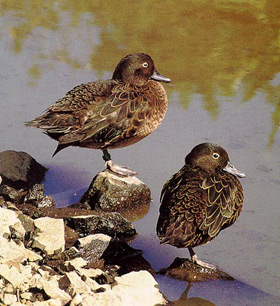
Brown teal Anas chlorotis. Photo Copyright © Geoff Moon
 View slideshow of larger teal images View slideshow of larger teal images |
| |
 |
| |
The related Campbell Island teal Anas nesiotis and the Auckland Island teal Anas aucklandica which have the same white eye ring as brown teal, have been isolated in New Zealand for a much longer time, and subsequently became flightless and semi-nocturnal.
The white eye rings of the three original New Zealand teal species distinguish them from the Australian grey teal and chestnut teal.
During the breeding season, mainland males get dressed up with glossy green plumage on their head, a narrow white neck collar, and white patches on their flanks. Island birds are not so flash.
They are 48 cm long, males weigh about 600 grams, and females are smaller at 500 grams.
Anas chlorotis is listed as 'critically endangered' on the IUCN 2005 Red List of Threatened Species. Its decline is described as ‘arguably, more dramatic than any other of New Zealand’s endemic birds’ [Williams 2001].
Brown teal were hunted until they were given full protection in 1921. They were vulnerable to hunters because of their reluctance to fly when disturbed. |
| |
|
|
| |
|
| |
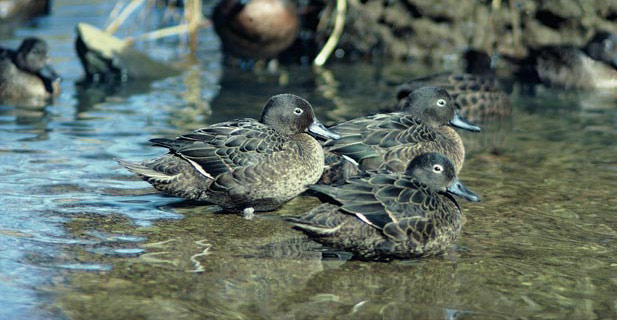
Above: North Island brown teal Anas chlorotis 'North Island', Great Barrier Island, Hauraki Gulf.
Photo Dick Veitch, Crown Copyright © Department of Conservation.
View slideshow of larger teal images
See more on teal |
| |
|
| |
North Island brown teal
Anas chlorotis 'North Island'
Brown teal were once widespread on freshwater wetlands throughout the mainland and the Chathams Islands, as indicated from fossils recorded from eleven North Island archeological sites.
It was common in kahikatea Dacrycarpus dacrydioides forest swamps, but occupied a diverse range of habitats, including estuaries, tidal flats, beachs, rivers, hill swamps, mountain lakes, pasture and forest.
North Island brown teal have been forced to primarily become a coastal and island inhabitant, as a result of wetland drainage, estuary development, introduced mammal predation, and hunting.
Brown teal feed on aquatic or marine invertebrate insects and their larvae, or crustaceans. Pipi Paphies australis and the wedge shell Macomona liliana can be eaten whole and crushed in the gizzard.
Some brown teal have found a way to force their bill between New Zealand cockle shells Austrovenus stutchburyi to remove the flesh.
At night they will forage on land some distance from the streams used as a refuge during the day (Worthy 2002).
The main group of 600 birds of the North Island subspecies is on Great Barrier Island, and there are small groups at two Northland locations between the Bay of Islands and Tutukaka, totalling 300 birds.
Small groups translocated from captive breeding are on protected and pest-free Kapiti Island and Mana Island. There has also been a recent translocation to Tiritiri Matangi Island in the Hauraki Gulf.
The North Island subspecies is threatened, listed as 'at risk-recovering' on the 2012 New Zealand Threat Classification System. It is downgraded from the 2005 listing of 'nationally critical'.
The threat ranking of 'A' is because of the total population of 1,000, and a population increase of less than 10 percent. The qualifiers are that it is conservation dependent, is likely to be moved to a higher threat category if current management is stopped, and it is range restricted. |
| |
|
| |
South Island brown teal
Anas chlorotis 'South Island'
The South Island brown teal Anas chlorotis ‘South Island’ was removed from the 'nationally critical' category to 'data deficient' in the 2012 New Zealand Threat Classification System.
It is considered to most likely be functionally extinct, but not convincingly beyond reasonable doubt that the last individuals have died.
Fossil records from 16 archeoplogical sites in the South Island show that brown teal once occupied a wider range than that of any other New Zealand anatid. Habitats were as diverse as coastal dunes, lagoons, lakes, waterways, kahikatea swamp forests, and wet rimu forests and matai forests.
The areas occupied ranged from Stewart Island marine habitat without freshwater, to silver beech and dry mountain beech forests up to an altitude of 800m. |
| |
|
| |
 |
|
|
Brown teal were the most abundant native waterfowl .....
The remains of brown teal Anas chlorotis, representing 641 birds, are reported from 73 widely distributed sites throughout New Zealand. The fossil sites indicate the prehistoric use of a large range of palaeo-habitats [Worthy, 2002].
The frequency of anatids in fossil records from 28 sites throughout the North, South and Stewart Islands are an indication that brown teal was the second-most abundant waterfowl species to the extinct, flightless Finsch's duck Chenonetta finschi.
There is no living record of Finsch's duck, which flew to New Zealand 230,000 years ago during the Pleistocene glacial period. The last radiocarbon dating is from the late 1400s to the mid 1600s.
A total of 1028 Finsch's duck, 641 brown teal, 390 grey duck, 348 grey teal, 193 scaup, 29 blue duck, and 26 merganser fossils have been recorded at archeological sites [Worthy, 2002].
| |
 |
| |
Brown teal were three times more abundant than FInsch's duck 1500 to 2000 years ago. |
| |
|
| |
At the most prolific fossil site, Lake Poukawa in Hawkes Bay, 421 brown teal fossils were found, exceeding all other anatid fossils found at the site. There were 355 grey duck, 338 grey teal, 165 scaup, 46 Finsch's duck, and 2 merganser fossils.
Anatids are relatively abundant in fossil sites in the Waitomo karst and brown teal is the most abundant species overall [Worthy, 2002]. The Waitomo karst area is centered on the Waitomo caves, and lies between the Awakino and Waikato Rivers.
Data from the Waitomo F1c cave show changes in relative frequency of brown teal and Finsch's duck [Worthy, 2002]. In the period 1500-2000 years ago, brown teal were three times as abundant as Finsch's duck, whereas 12,000 years ago, there were three Finsch's duck to one brown teal.
References
Robertson, H.A., Dowding, J.E., Elliott, G.P., Hitchmough, R.A., Miskelly, C.M., O’Donnell, C.F.J., Powlesland, R.G., Sagar, P.M., Scofield, R.P., Taylor, G.A., 2013: New Zealand threat classification Series 4; Conservation status of New Zealand birds, 2012, New Zealand Department of Conservation.
Worthy, T.H., 2002: Fossil distribution of brown teal (Anas chlorotis) in New Zealand. DOC Science Internal Series 81. Department of Conservation, Wellington. 29p
|
|