|
|
| |
| |
| |
NEW ZEALAND ECOLOGY |
| |
|
|
FRUIT - EATING BIRDS |
| |
Fruit-eating birds play an important ecological role in dispersing seeds of podocarp and broadleaf trees, and shrubs. Their job is essential in sustaining healthy forests, and regenerating new forest. Before humans arrived in New Zealand, the flora of fleshy-fruited plants evolved on an isolated land mass for 70 million years with no terrestrial mammals, apart from three species of bat, the only animals other than birds that eat fruit whole and disperse seeds. As almost completely frugivarian, pigeon are the best dispersers, able to swallow and digest the largest karaka and hinau fruit. |
|
|
|
| |
| |
|
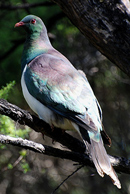
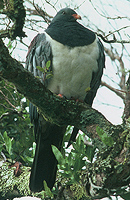
Once abundant in lowland forests, endemic kereru have followed similar decline to all native birds. As a frugivorous bird mainly reliant on the fruit of native plants, kereru populations have decreased as forests were removed. It has fell victim to a long history of hunting, being one of the largest forest birds, plump and palatable when gorging on seasonal fruit. Kereru play a key role, eating fruit and excreting the seeds of 70 plant species, including 16 large native trees.  See more See more |
 |
|
The parea is only found in the Tuku Nature Reserve and forest remnants on Chatham Island. The total population got as low as 40 in 1986, but has recovered, mainly because of predator and hunting control, and by 1996 there were 200 birds. Hemiphaga chathamensis has a larger body, shorter wings and tail, and other appearance and structural differences from H. novaeseelandiae, which is widespread on the mainland and offshore islands. See more |
 |
|
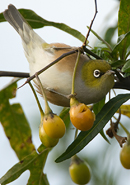
Silvereye are prolific fruit-eaters - often just flesh but also the whole fruit. They disperse kohekohe and supplejack vine fruit, which have a diameter of 9mm and 10.5mm. Its' maximum gape opening of 6.3mm, and mean gape of 5.1mm is the smallest of the fruit-eaters. It has been seen swallowing 9.9mm fruit, 1.9 times the size of its gape. Silvereye are 12cm long, the smallest tree seed-disperser. It is a recent immigrant, probably after trans-Tasman Ocean storm crossings before 1832. See more |
 |
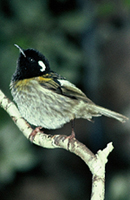
Stitchbird (Hihi) Notiomystis cincta
The stitchbird's main food is nectar from flowers of 20 native plants, and the fruit of 30 species, including two coastal trees karaka and kohekohe, supplejack vine, Coprosma species, five finger, pate and tree fuchsia. Its' maximum gape of 8.6mm is close to that of the bellbird, and the mean 7.1mm gape is a bit larger. The stitchbird is nationally endangered, and the only member of the endemic Notiomystidae family. It was reduced to one Little Barrier Island population, but has been reintroduced to three offshore islands and two mainland locations. |
 |
|
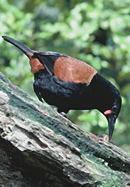
The North Island saddleback is the strongest survivor of New Zealand's wattlebirds, mainly because it is on 12 offshore islands, and 5 fenced mainland areas cleared of predators. Until a century ago, both species were common in podocarp forests on both mainland islands. South Island saddleback nearly became extinct with 36 birds on one island, but now number 1200 on 15 islands. Kohekohe fruit 9mm wide is swallowed whole by saddleback even though its gape may be as low as 7mm.
See more |
 |
| |
 |
| |
Above top: Kereru, Copyright © 2010 G. Woodhouse. 2nd down: Parea, Crown Copyright © Department of Conservation. 3rd down: Silvereye, photo A. Walmsley, Copyright © Wildfocus. 4th down: Male stitchbird, photo Dick Veitch. Above: North Island saddleback, photo J.L. Kendrick, Crown Copyright © Department of Conservation.
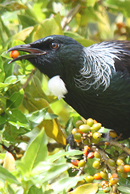
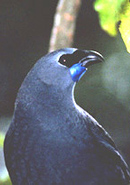
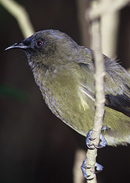
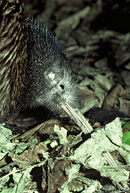
Above right top: Tui, photo Gareth Rapley. 2nd down: North Island kokako, photo Rogan Colbourne. 3rd down: NZ bellbird, photo Paul Schilov. 4th down: North Island brown kiwi, photo Rod Morris, Crown Copyright © Department of Conservation. Bottom right: Weka, Copyright © Virtual New Zealand. |
| |
|
| |
 |
| |
|
|
| |
Above - 1st image: Kereru, Rocky Bay, Waiheke Island,
Copyright © 2010 Graeme Woodhouse.
2nd image: Tui, Raoul Island, Kermadec Islands, photo Gareth Rapley.
3rd image: New Zealand bellbird, Tiritiri Matangi Island, Hauraki Gulf,
photo Paul Schilov, Crown Copyright © 2000 Department of Conservation.
4th image: Silvereye, photo A. Walmsley, Copyright © Wildfocus. |
|
| |
|
Kereru and tui are the main dispersers of seeds of 10 large native trees, including karaka with the largest fruit 17.5mm in diameter. Tui eat fruit from tawa, puriri, miro, titoki, pigeonwood, black maire, matai and kohekohe; and smaller Coprosma and Pseudopanax species. It is also an insect and nectar feeder with an important role in pollinating kowhai, pohutukawa, rata, kahikatea, rewarewa and flax. Tui are the finest songbird with a repertoire of cackles, barks, clicks and bell-like notes. See more |
 |
|
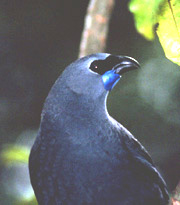
Kokako consume the fruit of 12 trees and supplejack, but are no longer a significant seed disperser because of their limited range. Despite a gape of 16.5mm, it can swallow the large 19.6mm fruit of taraire. Kereru are the only other taraire fruit-eater. Kokako also disperse the seeds of tawa, puriri, miro, titoki, mangeao, black maire, pigeonwood, matai, hinau, kohekohe and nikau. See more |
 |
New Zealand bellbird Anthornis melanura
Kereru, tui, bellbird and silvereye are responsible for 84 percent of seed dispersal. Bellbird eat fruit from two podocarp trees, miro and matai, as well as pigeonwood, and supplejack vine. Its' gape is only 8.5mm and the mean is 6.5mm, but it has been reported to have swallowed 9.7mm fruit. The bellbird is also an insect and nectar feeder, pollinating some of the same plants as tui. It has a beautiful song, liked so much by tui that they imitate it. |
 |
|
North Island brown kiwi have been observed feeding on the fruit of 3 trees, miro with a diameter of 13mm, and hinau and nikau which are 9.2mm and 9.1mm. Kiwi have a varied diet of small invertebrates, seeds, many varieties of worms, fruit, small crayfish, and amphibians. While brown kiwi have the largest gape (24mm) of any New Zealand extant terrestrial bird, it does not consume the largest tree fruit. Being flightless, it is restricted to fruit on the ground.
See more |
 |
|
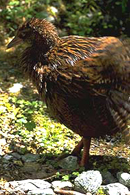
The weka is an endemic flightless rail that was abundant until the 1980s, but has since been in rapid decline. Surveys in 1991 and 1995 of the main population in the Gisborne region show only 1500 birds. It is New Zealand's odd bird out since it is a predator of the eggs of other birds. Weka disperse seeds of miro, pigeonwood, matai, hinau and kohekohe. Its' 13mm wide gape is a millimetre smaller than kereru, however, weka have not been seen eating fruit larger than miro, which is the same width as its' gape.
See more |
 |
Other minor native frugivorian birds
Other native birds that are minor frugivores, but may not be significant seed dispersers, include the New Zealand robin Petroica australis, yellowhead Mohoua ochrocephala, whitehead Mohoua albicilla, brown creeper Mohoua novaeseelandiae, pied tit Petroica macrocephala, fantail Rhipidura fuliginosa, grey warbler Gerygone igata, and rifleman Acanthisitta chloris. Their gapes are all 5mm or less in width. |
| |
|
|